
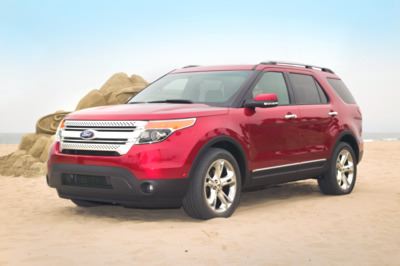
REINVENTION OF FORD EXPLORER 2011 Ford Explorer
DEARBORN, Mich., July 26, 2010 – Ford Explorer – the vehicle that
defined a segment – has been completely reinvented, raising customers’
expectations of sport utility vehicle (SUV) fuel efficiency, safety,
technology, capability and quality.
“The all-new Explorer will deliver today’s SUV buyers the attributes
they really want and value, and a few they might not even have dreamed
of,” said Mark Fields, Ford president of The Americas. “We’re proud to
introduce the new Explorer to customers and fans around the world today
and pleased to begin a whole new era that blends strong SUV fuel economy
and performance.”
The all-new Explorer launches today to its Facebook friends in a unique
social media initiative, followed by reveal events throughout the U.S.
and Canada.
Shattering SUV fuel economy and performance expectations
“The new Explorer simply does everything well,” said Derrick Kuzak,
group vice president, Global Product Development. “It raises the bar for
ride and handling on the road and transforms the off-road experience.
It’s the hands-down winner for towing capability and ease. All this
capability – and three rows of seating – with amazing fuel economy will
make Explorer the absolute right choice for families with a sense of
adventure.”
The 2011 Explorer with V6 power is expected to deliver more than 20
percent better fuel economy than the 2010 model, shattering conventional
expectations for SUV fuel efficiency. When equipped with the available
2.0-liter EcoBoost™ I-4
engine, Explorer fuel economy is expected to improve by more than 30
percent and exceed the 2010 Honda Pilot and 2010 Toyota Highlander V6.
Chief Nameplate Engineer Jim Holland said the team targeted two key
objectives when developing the 2011 Ford Explorer.
“It had to look modern and contemporary – inside and out – yet be
instantly recognizable as an Explorer,” said Holland. “Next, the new
Explorer needed to deliver the fuel economy today’s customers want,
combined with the performance, capability and empowerment they expect
from an SUV.”
Driven by the commitment to give customers unsurpassed fuel efficiency
with each new vehicle, Ford attacked every detail to transform Explorer
with significantly improved fuel economy:
Weight reduction is a key element in improving Explorer fuel efficiency.
While adding significant content to the vehicle, engineers were able to
reduce total vehicle weight by almost 100 pounds through the use of
lighter materials such as an aluminum hood. Explorer weight loss is even
more impressive, as the latest versions of Honda Pilot and Toyota
4Runner have added pounds versus previous models.
Explorer’s available advanced 2.0-liter EcoBoost I-4 delivers the power
of a normally aspirated V6 without compromising four-cylinder fuel
economy. Aimed at the SUV buyer whose top priority is fuel economy, this
turbocharged and intercooled I-4 engine delivers a projected 237
horsepower at 5,500 rpm and 250 lb.-ft. of torque from 1,700 through
4,000 rpm. The EcoBoost employs direct injection of gasoline, Ti-VCT,
direct-acting mechanical bucket (DAMB) valve lifters and four valves per
cylinder.
Explorer’s standard powertrain combines front-wheel drive with a
3.5-liter Ti-VCT V6 engine, delivering an estimated 290 horsepower and
255 lb.-ft. of torque. Ti-VCT allows individually optimized camshaft
timing of valve opening and closing events to improve mechanical
efficiency while delivering increased power and reducing part-throttle
emissions. Mated to a six-speed automatic transmission, this powerful,
flexible and efficient V6 is projected to deliver more than 20 percent
better fuel economy versus the previous Explorer V6 model.
Explorer’s variable-displacement air-conditioning compressor provides a
fuel economy benefit with less drag and smoother transition for improved
driveability.
Each Explorer engine is paired with a unique six-speed automatic
transmission, combining lowered initial gears for improved off-the-line
acceleration and higher gearing for improved efficiency at lower engine
rpm when cruising.
Explorer V6 models are available with an intelligent 4WD system that
adds terrain management. Situation-selectable, this powertrain
advancement takes the guesswork out of 4WD range choice.
A driver need only turn the console-mounted knob to the proper setting
among snow, sand, mud and normal modes. This system also includes a hill
descent mode.
Simpler and more convenient for SUV veterans, the system will be a
confidence-builder for drivers new to the segment.
Contemporary design with segment-leading craftsmanship and quietness
In addition to its clean, modern design inside and out, Explorer aims to
please SUV shoppers with a thoughtful, flexible interior package that
abounds with clever storage capacity. The new SUV features more head and
shoulder room, three rows of flexible seating, and room for everything
families want to take along on their adventures.
The Explorer design – inside and out – is executed with world-class
craftsmanship. Tight margin gaps are just one indication of the immense
attention to detail applied to craftsmanship across the spectrum, from
design to engineering to manufacturing.
The Chicago facility where Explorer will be produced raised the bar on
initial quality measures with the recent Taurus launch, which is good
news for customers.
“Crafting a high-quality vehicle is like preparing a gourmet meal,” said
Peter Bejin, craftsmanship supervisor. “You start with high-quality
ingredients, execute your recipe with flawless preparation and finally,
present it with flair and panache.”
Quietness – another profound advancement in the all-new 2011 Ford
Explorer – also will signal quality to customers.
The team enhanced noise, vibration and harshness (NVH) control for the
all-new Explorer using an advanced technology called NoiseVision. A ball
with hundreds of tiny cameras and microphones, NoiseVision allows
engineers to pinpoint and address potential noise issues earlier in the
development process.
Explorer is expected to be superior to in-segment competitors and rival
premium SUVs in quietness and NVH control.
Explorer safety – strength, technology and innovation
The all-new Explorer targets top safety ratings with a stiff unibody
structure and a class-leading suite of active and passive safety
features and technologies, plus another Ford safety innovation – the
world’s first second-row inflatable rear belts.
Rear seat passengers – often children or mature passengers – can be more
vulnerable to head, chest and neck injuries. Ford’s unique inflatable
rear belts spread impact forces across more than five times the area
than conventional seat belts, reducing pressure on the chest while
helping to control head and neck motion. Belt comfort should also help
increase usage rates. Studies show inflatable belts to be more
comfortable for passengers due to padding.
From the boron front bumper beam through the hydroformed front frame
rails and high-strength steel side-impact tubes, Explorer’s rigid body
structure is designed to provide robust protection for occupants. In the
instance of a crash, these elements come together to protect Explorer
driver and passengers inside a safety cage of strength.
Standard Explorer safety features include:
Available Explorer safety features include:
Stretching the breadth of capability
The 2011 Ford Explorer redefines customer expectations for driving
dynamics and comfort – on any road, anytime, anywhere – while stretching
the breadth of SUV capability. Transforming Explorer’s driving quality
was central to creating an SUV for 21st century customers.
“Our objectives for Explorer dynamics were threefold,” said Carl Widmann,
vehicle engineering manager. “The first element was to greatly increase
on-road comfort, capability and driving dynamics. The second was to
maintain the ‘any road, anytime, anywhere’ capability of the previous
model. Finally, we aimed to apply technology to the task of safely
towing, as V6 Explorer models are rated up to 5,000 pounds. We think
customers will be pleased with the next-generation Explorer on all three
counts.”
The theme of the all-new Explorer dynamics development was balance. The
team sought to provide an engaging driver experience in harmony with the
extended breadth of 4WD capability to build driver confidence.
The shift to a unibody construction platform enabled a reduction in road
noise and significantly decreased Explorer body roll in dynamic
cornering situations. Independent front suspension is of the short- and
long-arm configuration with a 32-millimeter front stabilizer bar.
Independent rear suspension is the SR1 configuration, so-named for its
one-to-one shock absorber ratio, which enables precise ride control.
Explorer’s EPAS system allows for variable rates of assistance based on
speed, turn-in and direction. In addition to optimized steering feel,
tight on-centering and appropriate resistance, EPAS provides a fuel
economy benefit in comparison to traditional hydraulic power assist
systems. EPAS also enables a competitive turning radius for optimum
maneuverability in parking situations, combined with increased
assistance at low speeds for parking ease.
EPAS allows for the addition of Curve Control, a new feature that senses
when a driver enters a turn too quickly and applies brake pressure to
stabilize the vehicle.
In addition, EPAS enables the optional active park assist technology.
When activated, the system scans for a suitable spot, calculates the
trajectory, and steers the vehicle. The driver continues to control
brake and throttle inputs, but the system steers the vehicle throughout
the parking maneuver.
Off-roading standout on a variety of surfaces
The key to Explorer 4WD capability is Ford’s new terrain management
system.
Replacing the traditional SUV transfer case configuration, the new
system takes the guesswork out of maximizing 4WD and the capabilities it
enables. Rather than employment of four-high, four-low and auto
settings, Explorer terrain management is selectable by situation. The
four settings – available by shift-on-the-fly – include normal, mud,
sand and snow.
Each setting provides unique engine behavior, throttle tip-in,
transmission shift scheduling and calibrations for traction and
stability control systems. Terrain management also includes Hill Descent
Control™,
which provides engine braking to increase driver confidence and control
when descending a steep incline.
Explorer models with V6 power are rated to tow a maximum of 5,000
pounds. To aid with hookup – especially when alone – a reverse camera
with zoom-in functionality is available, allowing a driver to back up to
the trailer on-center. The Explorer towing package includes trailer sway
control – a stability package shared with the Ford F-150 pickup – to
help minimize trailer sway. Trailer brake controller wiring is also
included, as is a tow/haul mode. Engaging tow/haul mode increases engine
braking to help slow the vehicle and trailer when descending steep
grades.
Loaded with features, convenience and connectivity
The all-new Explorer is available in three trim series levels – base,
XLT and Limited. Each offering presents a robust array of standard
features, with a class-leading selection of additional convenience and
connectivity options so a buyer can tailor a new Explorer to his or her
individual needs and desires.
Standard convenience features include:
Explorer XLT includes standard content and adds:
Explorer Limited includes all base and XLT content, plus:
“We spent our time listening to customers and addressing their needs to
launch an SUV that reinvigorates the Explorer nameplate and delivers on
Ford’s promise of high-quality, fuel-efficient and technologically
advanced vehicles with industry-leading safety,” said Holland. “The
all-new Explorer will change market perceptions about SUV style, fuel
efficiency, technology and user-friendliness.”
The 2011 Explorer will be assembled at Ford’s Chicago manufacturing
facility. Production begins late this year, and Explorer will be
available in dealerships this winter.
|
EXPLORER4X4 | EXPLORERFORUM | EXPLORERSPORTRUCK
"Serious Explorations"® is not affiliated with or endorsed by the Ford Motor Company.
